installation works
Skog og li og bekker forbi
(2025)
horn speakers, solar panel, battery, charging regulator, microcomputer, amplifier, synthesized voice, real-time sound processing
duration open

Momentum13, Galleri F 15, Jeløy/Moss, Norway, 2025
Skog og li og bekker forbi (Forests and hills and streams passed) plays on the liminal space—the historically ambiguous in-between realm—between humans and other-than-humans, as found in folklore, legends, and oral culture in Norway. The work is based on descriptions and stories of a time when humans and other-than-humans were closer to one another and could understand each other; when the distinction between human and nature was not clearly defined. The work highlights enduring aspects of Norwegian folklore, their link to sorcery laws and witch trials, and our current ambivalent relationship between our own human nature and the non-human nature we inhabit and harvest from.
The sound elements in the work are inspired by legends and stories about the huldrefolk—creatures with magical abilities and a close connection to nature and farming. Stories of this underground people have their origins in pre-modern times and have been passed down through generations. Both women and men could fall victim to the hulders, who lured people with their beautiful voices. Hulders are mostly invisible, but can appear for a short time before suddenly disappearing. In the legal texts of sorcery laws implemented from the 16th century onwards, one can recognize descriptions of abilities once attributed to the huldrefolk. This was a time of great disparity between rich and poor, with much envy and suspicion. Accidents and illness were attributed to witchcraft performed by some local scapegoat, most often a poverty-stricken outsider. What had previously been caused by a lack of cooperation with an invisible nature-people was now humanized, incorporated into the legal framework, and severely punished. The sorcery laws in Norway were abolished only in 1842.
The sound material consists of computer-generated voices devoid of human language. Hence, the voice indicates a presence without delivering a message. It is manipulated to become ambiguous as to whether the sound is that of an animal or a human—the voice might be recognizable on an intimate level, but at the same time feel unfamiliar.
Vannet vet
(2023/2025)
multi-channel sound, field recordings, hydrophone recordings, sound synthesis, real-time sound processing, solenoid, steel water bowl
duration open

TEKS.studio, Trondheim, Norway, 2025
The work's title (Water Knows) refers to water as an omnipresent element and life-giving force. Water is in everything and everyone, is essential for all life, and connects us to the earth and to each other. All bodies of water are connected to all other through evaporation, movement, and precipitation. Water, in all its forms and states, is essential for the many processes that lead to variations of seasons and life-cycles.
Vannet vet takes as its starting point issues surrounding the global water crisis, which has emerged and continues to worsen due to climate disruption, pollution, economic inequality, and environmental degradation. The installation further points to the cultural significance of water as a life-giving and essential force and its role in traditional and indigenous contexts.
The sound material consists of recordings of water in various forms—snow, ice, and liquid and running water above and below the water surface. Sound processing and spatialization in the work are based on aspects of the associated natural processes: dispersion, accumulation, impact and overflow. Real-time sound processing ensures that the soundscape never repeats—the combination and spatialization of the sound elements vary throughout the entire exhibition period. The formal progression takes place on several time scales in parallel. Transformations between the water states (gas, liquid, solid) take place continuously and act as a link between sea and land. Larger spatial movements in the soundscape refer to ocean currents and cloud patterns that regulate global heat exchanges. The transformations and movements in these cycles are gradually made less regular over the course of the exhibition to reflect the increasingly unpredictable effects of global climate disruption.
Vannet vet was commissioned by HilmArt / the Hilmar festival for the exhibition “TJAETSIE / VANN” at Saemien Sijte (South Sámi Museum and Cultural Center) in Snåsa and at Telegrafen in Steinkjer, Norway in October and November 2023 respectively. The work has a flexible format and is configured specifically for the site where it is installed.
Livello del mare estremo|Terra perduta
(2023)
multi-channel sound, field recordings, hydrophone recordings, generative sound processing
duration open
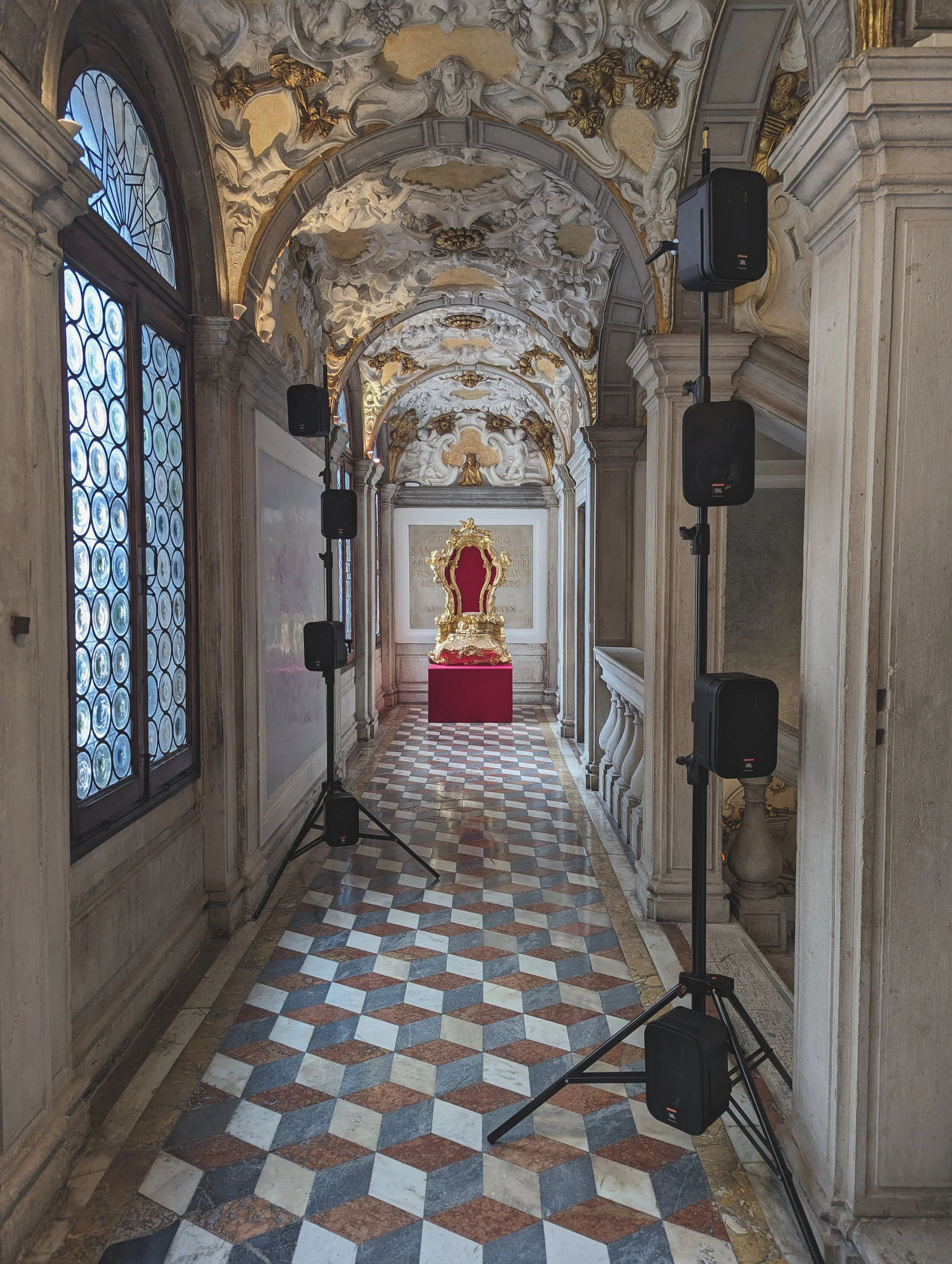
Scuola Grande dei Carmini, Venice, Italy, 2023
Livello del mare estremo | Terra perduta takes a speculative, long-term view on sea level rise in Venice using generative algorithmic processing and spatialization. The sound material is based on above and below water recordings of the Venice Lagoon and canals, and the installation builds on historical sea level data from tide gauges starting in 1872 until present day, as well as projected sea level rise by the year 2100. The artwork is installed in a vertical sonic display. This is the first stage of a long-term art-research project that continue in Venice and other coastal regions, using local sea level data and source recordings for each subsequent site.
The generative processes are centered around four main components: 1) above-water recordings, starting near floor-level and gradually rising vertically in an immersive manner; 2) gradually introducing below-water recordings that eventually dominate the immersive sound environment; 3) randomly occurring events of “acqua alta”—sudden increase and subsequent decrease in vertical water level based on historical and current data of high-water occurrences; and 4) randomly spatialized recordings of sea fauna, increasingly occurring in parallel with rising below-water recordings. Sonification is based on long-term data for Apparent Sea Level Rise (ASLR), which is the combination of the effect of land subsidence and climatic sea level rise.
Livello del mare estremo | Terra perduta is created in collaboration with artist Luz María Sánchez (MX/NO).
Alle talte samme språk
(2020)
multi-channel sound, environmental sensors, textiles, sound synthesis, real-time sound processing
duration open
Ingenmannsland
(2019)
multi-channel sound, field recordings, real-time sound processing
duration open
Museum Angewandte Kunst, Frankfurt, Germany, 2019
Ingenmannsland (2019) is a constantly changing, speculative soundscape highlighting issues of deforestation, resource extraction, habitat loss, species extinction and natural vs. artificial life. The installation takes as a starting point the rainforest that once lined much of the western coast of Norway, providing life-giving stability for centuries. Today only scattered fragments remain of this forest, and it is now on the red-list of endangered habitat types. 80 percent of the rainforest have been lost only in the past 100 years, and it is predicted to disappear completely within the next five decades. The installation is a long-duration, generative work where sound elements undergo real-time transformations following a trajectory that reflects historical and projected data on deforestation and extinction. The work plays with time-scaling and human perception to portray a symbiotic relationship that goes from one of reciprocal, sustainable natural processes to one where the aid of artificial life-forms becomes a necessity. The title, meaning no-man's-land, refers both to land unclaimed and undisturbed by human activities as well as to the frontlines of areas of conflict. The ambiguity of this expression is reflected in the work, which questions the connection between cultural identity and nature, which on the one hand is perceived as something plentiful, permanent and unbreakable, but on the other is subjected to a contemporary reality of fragmentation, rapid change, and the effects of climate disruptions and economic pressures.
Ingenmannsland was commissioned for the exhibition “House of Norway” at Museum Angewandte Kunst in Frankfurt am Main, Germany in 2019. The work has a flexible format and is configured specifically for the site where it is installed.
See here for further details.
Birding the Future
(2013 - ongoing)
multi-channel sound, real-time sound processing, stereoscopic composite photographs, stereoscope
duration open

2016 Arts in Foggy Bottom Sculpture Biennial, Washington DC, USA
Birding the Future is an interdisciplinary project that explores aspects of species decline and biodiversity by specifically focusing on warning signals from birds as indicators of environmental health. It is an installation project that combines multichannel sound, stereo images, text, sculpture, video, Morse code, and audio recordings of threatened and extinct bird species, as well as a sonic rendering of projected species extinction rate. The project offers a multi-perspective approach, linking multiple histories that overlap and connect birds, humans, cultures and places and the ways in which technology mediates those encounters. Most of the benefits as well as destruction of biodiversity occur at a local level. By focusing on local ecosystems in a number of regions across the world, the project combines notions of site-specific and site-adaptable to highlight regional issues while simultaneously mapping global commonalities. The work draws on traditional ecological knowledge, biology, climate research, urban development, statistics and data analysis, as well as conservation efforts and environmental challenges in the region where the installation is presented. While the individual series have a common format, the content is developed specifically for each region based on up-to-date research.
As of 2025, the project consists of nine completed series: Queensland Australia Series, Arabian Peninsula Series, Norway Series, Mid-Atlantic USA Series, Rhein-Main Germany Series, Barrow Valley Ireland Series, Lab Series focusing on laboratory birds, and Names Series and Serie de Nombres, with a focus on naming. An additional two series have been commissioned for Mexico and Colombia, and are under development for completion and exhibition in 2026.
Birding the Future is created in collaboration with artist Krista Caballero (USA). In addition to the installation, the project includes a web site that serves as an archive while seeking to map and connect regional issues of biodiversity with a global perspective. Visit birdingthefuture.org for details.
From the Car
(2006)
2-channel video, multi-channel ambisonic sound
120 minutes, continuous loop

Arizona State University Art Museum, Tempe, Arizona, USA
From the Car was commissioned by the Arizona State University Art Museum as part of the group exhibition New American City: Artists Look Forward, focusing on the role of art and artists in the rapid growth and expansion of the Phoenix area in the southwestern USA. From the Car comments on the massive sprawl and car-centric planning of the expansion of the city. The source material includes video footage shot through the side window of a car while driving for one hour north, south, east and west from the exact center of downtown Phoenix, as well as the sound of traffic, air conditioners, car alarms, traffic reports, temperature forecasts, airplane noise and other soundmarks typical of this major desert city.
The work is designed for installation in a rectangular room with video on two opposing walls and loudspeakers appropriately placed without obstructing the projection screens.
From the Car was created in collaboration with photographer Betsy Schneider (USA).
7 minutes
(2005)
4-channel audio, real-time sound processing, video, photography, poetry recitation
duration open
7 minutes was created in collaboration with photographer Brent Hirak (USA) and writer Kriste Peoples (USA). It was first installed at the kitchenette gallery in Phoenix, Arizona, USA.
Lorry Red Lorry Yellow
(2000)
4-channel sound framed text with braille translations
duration open
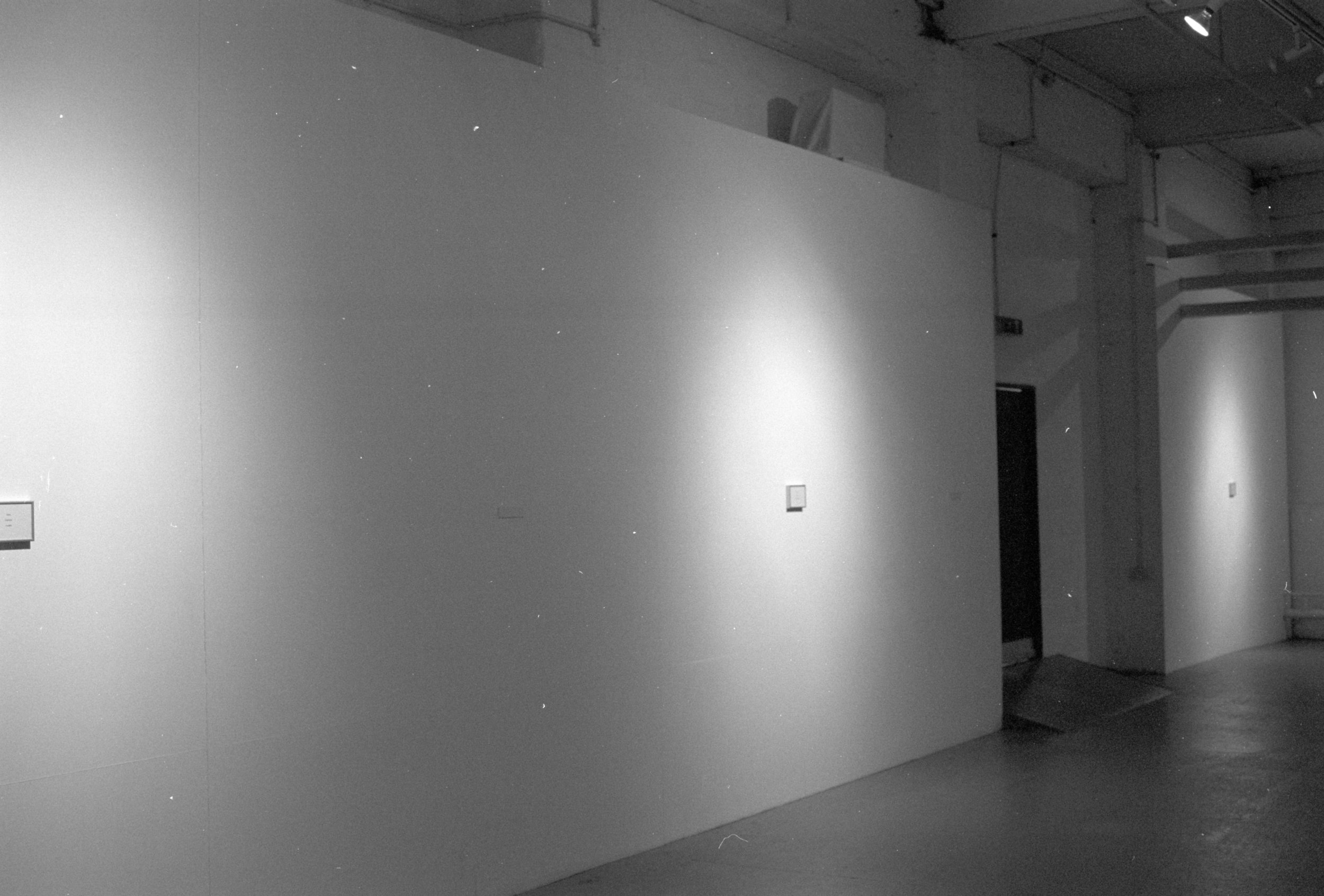
The gallery@The Central School of Speech and Drama, London, UK
As silence is increasingly difficult to come by, sound is virtually a constant in our lives. Yet we often really notice sound when it's extremely offensive or pumped out in a familiar and slick package; everything else becomes background. But what is this background sound? What are we hearing and how does this constant passive, semi-conscious listening affect us?
Lorry Red Lorry Yellow consists of a virtually infinite number of permutations of sounds taken from both outside and inside the exhibition
space. These ubiquitous yet ignored sounds are taken out of context and put into a gallery where they become a highlighted version of themselves. They are sounds we hear everyday, part of the fabric of the background, sounds which we have all learned to block out. Presented in a gallery setting will they command attention? Out of context, do they become important? In Lorry Red Lorry Yellow, we put sound up for consideration. This piece is a nod to sound as an integral part of the formula which defines our quality of life. Above all else, this piece is an invitation to the audience to listen to each sound in the din of life.
Lorry Red Lorry Yellow was commissioned by The Central School of Speech and Drama in London, UK, and created in collaboration with composer Jo Thomas (UK).
I grevinnens tid
Ringve Music Museum, 2016
Multi-room sound design, ambisonic and multi-channel sound
I grevinnens tid (In Time with the Countess) is a historical exhibition at the Ringve Music Museum in Trondheim, Norway, focusing on music and people in the city of Trondheim in the years 1740-1815.
Deer Valley Rock Art Center, 2011
Parabolic speaker system, motion sensor, spoken word
Sound restoration and editing of exhibition sound material, as well as installation of sensor-controlled, parabolic listening system for the Deer Valley Rock Art Center in Phoenix, Arizona, USA.